Buying Land in India as an NRI? Check Groundwater Before You Invest
You have spent years abroad. You have saved carefully. And now you are ready to invest in land back home — a plot in Telangana, farmland in Karnataka, a site near your hometown in Andhra Pradesh or Maharashtra. You have spoken to a local broker. You have checked the pattas and encumbrance certificate. You have verified the boundaries. You may have even visited once. But there is one question almost no NRI asks before the money is transferred — and it is the question that determines whether that land is worth what you are paying for it.
REAL ESTATE WATER RISK
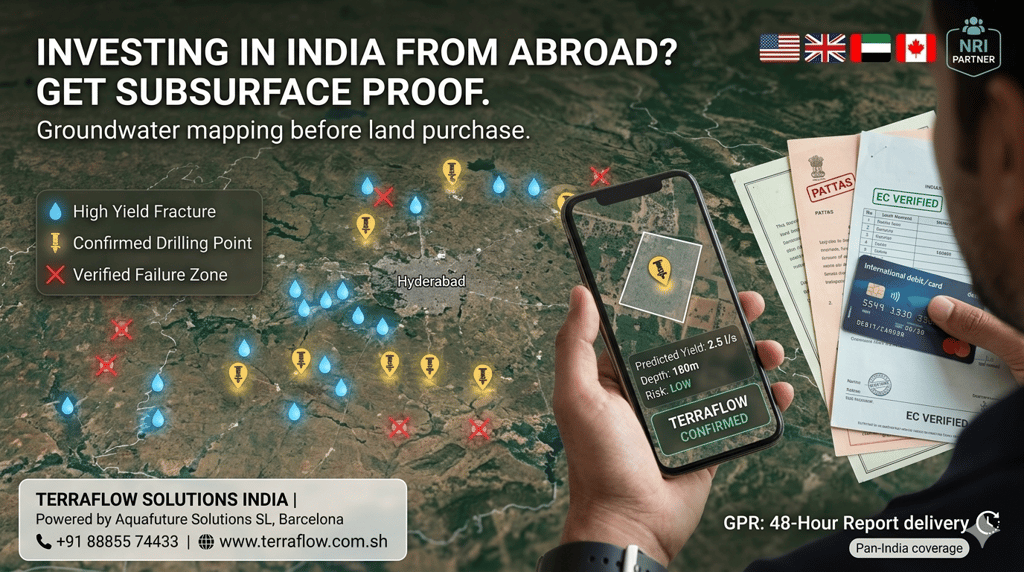
Does this land have reliable groundwater? And if you drill a borewell, will it succeed?
Groundwater is invisible. It does not show on a title deed. It is not verified by any broker or registration office. And in hard rock terrain — which covers the majority of South and Central India — the difference between a productive borewell and a completely dry well can be as little as 50 metres laterally.
This guide is written specifically for NRIs who are buying or considering agricultural, residential, or commercial land in India. It explains the groundwater risk no one talks about — and how to get a definitive answer before your money leaves your account.
Why Groundwater Matters More Than You Think
For agricultural land, groundwater is not a bonus feature — it is the primary determinant of land productivity. A 10-acre plot in Nizamabad or Nalgonda that has no reliable water access is worth a fraction of what the same plot with a successful borewell commands. Crops, horticulture, and even land resale value are directly tied to water access.
For residential or layout plots, groundwater determines whether the site can support construction and habitation without depending entirely on municipal supply — which in most of Telangana and Andhra Pradesh is intermittent, seasonal, and increasingly inadequate.
For commercial and industrial sites, groundwater is a utility input. Without it, you are paying for water tankers indefinitely.
In Hyderabad's peripheral districts, a borewell failure on agricultural land can reduce the effective land value by 30 to 50 percent. Buyers find this out after purchase — not before.
The Problem NRIs Face That Local Buyers Often Do Not
A local buyer — a farmer, a developer, a resident — often has neighbourhood knowledge. They know which nearby plots have successful borewells. They can ask the adjacent landowner. They may have grown up in the area and have an instinctive sense of the terrain.
An NRI buyer has none of that. You are making a high-value decision from the UK, the US, the UAE, or Australia, based on what a broker tells you and what a relative confirms. Neither the broker nor the relative has access to subsurface geological data.
What brokers do not know — and cannot tell you
Brokers in India are not groundwater specialists. They are not required to disclose borewell risk. They will tell you that 'this area has good water' because the neighbouring farm has a successful borewell — without understanding that fracture zones in hard rock geology can vary dramatically within a single survey number.
A borewell that succeeded 200 metres from your plot may have hit a fracture vein that does not extend to your site. There is no way to know this from the surface — it requires subsurface analysis.
The cost of getting it wrong from abroad
A failed borewell in Telangana or Karnataka costs between Rs. 4 lakh and Rs. 10 lakh in drilling, casing, and pump installation — money spent on a dry well that produces nothing. For an NRI who cannot monitor the drilling in person, contractor fraud and over-drilling are additional risks on top of the geological uncertainty.
And unlike a local buyer who can course-correct quickly, an NRI dealing with a failed borewell is managing the problem across time zones, through intermediaries, from thousands of kilometres away.
Getting groundwater intelligence before purchase is not a luxury for NRI buyers — it is the due diligence that protects an investment made from abroad.
What a Satellite-Based Groundwater Risk Report Tells You
TerraFlow Solutions India delivers satellite-based groundwater risk assessment for any coordinates across India. The service is fully remote — there is no site visit, no need for you or anyone to be physically present at the land. You submit the GPS coordinates and receive a formal report within 48 hours.
The Ground Property Report (GPR) — TerraFlow's pre-purchase groundwater intelligence report — covers:
• Whether groundwater is likely to be present at your specific plot coordinates
• The subsurface geological formation profile — what layers exist from surface to borewell depth
• The target depth zone — where a productive aquifer or fracture zone is likely to be encountered
• Expected yield range — litres per second the borewell can realistically produce
• A formal risk classification — Low, Moderate, High, or Very High risk for borewell failure
• A confidence rating based on the fracture zone density and formation consistency at your location
This is not a generic district-level report. It is a site-specific assessment at your GPS coordinates — the actual plot you are considering buying.
The GPR tells you, before purchase: drill here, and here is what you will likely find. Or: do not drill here without further evaluation.
The Three-Step Process for NRI Land Buyers
1. Share the GPS coordinates of the plot — available from Google Maps or the land documents
2. Receive the Ground Property Report (GPR) within 48 hours — formal, documented, with risk classification and yield estimate
3. Make the purchase decision with full subsurface intelligence — not broker assurance
If the GPR confirms groundwater potential and the purchase proceeds, the next step before any drilling begins is the GPS Drill Targeting report — which gives the precise drill point coordinates on the plot to maximise success probability.
If a borewell already exists on the land, TerraFlow's Borehole Audit & Risk Management service assesses its current condition, yield sustainability, and whether re-drilling or deepening is advisable.
The service sequence matters. No GPR. No GPS. The sequence is the science.
Which States and Land Types Does This Cover?
TerraFlow provides Pan-India satellite groundwater risk assessment. For NRI buyers, the most common land purchase geographies we cover include:
• Telangana — Nizamabad, Nalgonda, Yadadri, Ranga Reddy, Medak, Vikarabad, Sangareddy districts
• Andhra Pradesh — Krishna, Guntur, Kurnool, Kadapa, Chittoor, Prakasam districts
• Karnataka — Bengaluru Rural, Tumkur, Kolar, Raichur, Dharwad, Belagavi districts
• Maharashtra — Nashik, Pune, Aurangabad, Solapur, Latur districts
• Tamil Nadu — Coimbatore, Salem, Erode, Madurai, Tirunelveli districts
• Rajasthan, Gujarat, Punjab, Haryana, Uttar Pradesh — covered on request
Agricultural land, residential plots, farmhouse sites, industrial land — all covered. The only input required is GPS coordinates.
Real Proof: What Satellite Intelligence Found That Drilling Alone Could Not
In Laxmapoor Village, Chandur Mandal, Nizamabad district, a landowner approached TerraFlow after multiple conversations with local drillers produced contradictory advice on where and how deep to drill. The GPR identified a cold water vein running SE to NW at 200 metres depth in fractured granite. GPS drill targeting pinpointed the exact drill location on the plot.
Water was struck exactly as predicted. The methodology — satellite-based remote analysis with no site visit — was validated completely.
The borewell succeeded. Not because of a lucky guess. Because the subsurface was mapped before the drill rig arrived.
TerraFlow's international project portfolio includes thermal water discovery at 430 metres in Kayseri, Turkey — where a EUR 5 million traditional drilling programme had already failed — and 79 groundwater reports across 6 of 7 provinces in Costa Rica. The same analytical intelligence is now available for every land parcel in India.
How to Get a Groundwater Report for Your India Land — From Anywhere in the World
The process is designed to work entirely remotely — no India presence required from you at any stage.
1. Visit terraflowsolutions.in and go to the GPR (Ground Property Report) service page
2. Submit your plot GPS coordinates via the WhatsApp pre-fill form or contact form
3. Complete 50% advance payment — invoice raised in INR, payment via standard bank transfer
4. Receive your formal GPR report within 48 hours — PDF format, shareable with your family, CA, or legal advisor in India
5. Use the report to make an informed purchase decision — or to negotiate the land price based on documented groundwater risk
You do not need to be in India. You do not need anyone to visit the site. You only need the coordinates.
NRI Buyer FAQ
I am buying land in a village area. Does satellite data work for rural plots?
Yes. Satellite-based geological analysis works for any coordinates across India, including rural agricultural land, village plots, and remote sites. The analysis does not depend on urban infrastructure or physical accessibility.
The broker says nearby borewells are successful. Is that not enough assurance?
No. Hard rock geology — which dominates South and Central India — is highly localised. A successful borewell 200 metres from your plot may have hit a fracture vein that does not extend to your site. The only way to know is a site-specific subsurface assessment at your exact coordinates.
Can I get a report before I finalise the purchase price?
Yes — and that is exactly the right time. A GPR report that indicates high borewell failure risk gives you documented grounds to renegotiate the purchase price or walk away from the transaction entirely.
The land already has a borewell. Do I still need a report?
Yes. An existing borewell tells you only that water was present when it was drilled — not its current yield, sustainability, or condition. TerraFlow's Borehole Audit & Risk Management service assesses existing borewells and gives you a clear picture of what you are inheriting.
How is payment handled for NRIs?
TerraFlow raises INR invoices payable via standard bank transfer. Contact us at terraflowsolutions.in or WhatsApp +91 88855 74433 for payment guidance.
Protect Your India Land Investment Before the Money Leaves Your Account
A satellite groundwater risk report costs significantly less than a single failed borewell — and a fraction of the land value you are protecting. It is the one due diligence step that title verification, encumbrance certificates, and broker assurances cannot replace.
TerraFlow Solutions India has delivered groundwater intelligence for land across Telangana, Andhra Pradesh, Karnataka, and beyond. The same service that guides developers and industrial planners is available to every NRI making a land investment decision from abroad.
→ Request your Ground Property Report at terraflowsolutions.in
→ WhatsApp direct: +91 88855 74433
TerraFlow Solutions India Private Limited
Official India Partner — Aquafuture Solutions, S.L., Barcelona, Spain
terraflowsolutions.in | +91 88855 74433